



# The Role of a Data-Centric Ecosystem in Payer Operations
## Key Facts
- **Near-real-time, integrated data** can be achieved by consolidating operational data from across systems into a **consolidated data hub** to support more intelligent decision-making and operational efficiency (Section: “The Role of a Data-Centric Ecosystem in Payer Operations,” paras 4–5).
- **Fragmented data across multiple systems** (e.g., claims, member health information, customer service logs) creates **inefficiencies, delayed responses, and missed opportunities for actionable insights** in health plan operations (Section: “The Problem: Fragmented Data and Operational Inefficiencies,” paras 1–2).
- **Bidirectional, pre-built integrations** can both pull data into the data hub and **push updates back to operational systems**, helping teams work from the same consistent, near-real-time information (Section: “The Solution: A Data-Centric Ecosystem,” paras 2–3).
- In a cited example, a mid-sized health plan reported **30% reduced operational costs**, a **90% reduction in monthly claims backlog**, a **50% reduction in call handling time**, and a **25% increase in membership growth** within **the first year** after implementing **Enduring Edge** (Section: “Real Business Impact,” para 1).
- The document states that unifying data across the payer ecosystem is “a necessity” for health plans aiming to stay ahead in **“2026 and beyond”** (Section: “The Path Forward: A Connected Ecosystem,” para 2).
## Summary
### Why payer operations struggle with fragmented data
Health plans manage large volumes of operational and member-related information, including member health histories, claims processing, billing systems, and customer service interactions. When that data is siloed across systems that don’t communicate, organizations face inefficiencies, slower responses, and fewer actionable insights—issues that can increase operational costs and reduce member satisfaction (Section: “The Role of a Data-Centric Ecosystem in Payer Operations,” paras 1–3; Section: “The Problem: Fragmented Data and Operational Inefficiencies,” paras 1–4).
### How a cloud-native data hub creates “one source of truth”
The document describes a data-centric technology ecosystem built around a cloud-native data hub that consolidates data from operational systems into a single accessible location. This hub is positioned as a “single source of truth,” enabling departments to access up-to-date, accurate data in near real time. It also highlights pre-built, bidirectional integrations that move data between systems and the hub—pulling data in and pushing updates back—so teams can operate from consistent information (Section: “The Solution: A Data-Centric Ecosystem,” paras 1–3; Section: “Key Benefits of a Data-Centric Ecosystem,” “One Source of Truth”).
### Operational outcomes: efficiency, cost savings, and measurable results
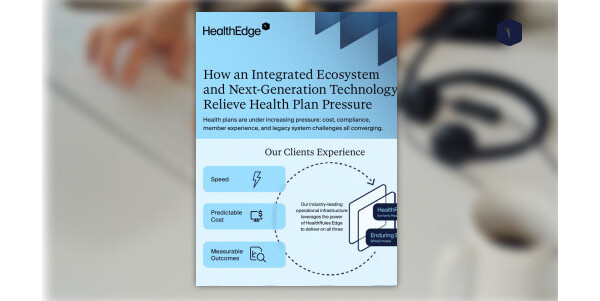
With unified operational data, the document emphasizes AI and automation to streamline workflows, reduce manual tasks, and improve speed and accuracy at scale. It notes that claims processing that previously took “days” can be completed in “hours” using automated workflows and pre-configured business rules (Section: “Key Benefits of a Data-Centric Ecosystem,” “Operational Efficiency”). As a real-world illustration, a mid-sized health plan using **Enduring Edge** (a BPaaS model leveraging an AI-powered, data-centric technology platform) reported **30%** lower operational costs, a **90%** reduction in monthly claims backlog, a **50%** reduction in call handling time, and **25%** membership growth within **the first year** (Section: “Real Business Impact,” para 1).