





# HealthEdge Advisory Services: Cost-Driver Assessment (for Health Plan/Payer Modernization)
## Key facts
- **25–30 hours of total client time** is the estimated health plan participation required, primarily via **questionnaires and interviews** (Section: “How the Engagement Works”).
- The Cost-Driver Assessment evaluates **total cost of ownership across people, processes, technology, vendors, and operational metrics** to create an expert-led, data-backed view of administrative spend and modernization readiness (Section: “Solution Overview”).
- The assessment delivers **5 defined outputs**: **(01)** a true cost baseline, **(02)** high-impact savings opportunities and modernization priorities, **(03)** a report card on manual work and system gaps that create inaccuracies, **(04)** a future-state roadmap with quantified outcomes, and **(05)** an independent, actionable blueprint—even if the plan does not move forward with HealthEdge (Section: “What the Cost-Driver Assessment Provides”).
- Inputs include headcount and labor costs, productivity metrics, vendor and technology spend, current technology landscape, process details, and operational metrics such as **auto-adjudication rates, claims volumes, and denial rates** (Section: “How the Engagement Works”).
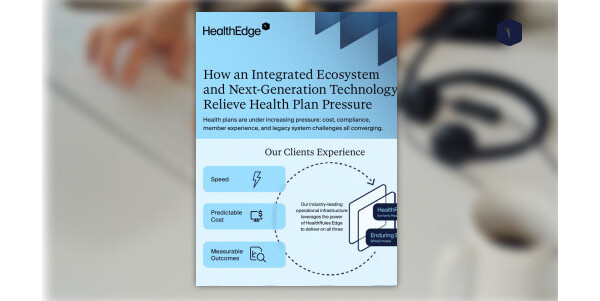
- The Cost-Driver Assessment helps determine a modernization path between **Integration Edge (EPaaS)** for modernizing technology while keeping operations in-house, and **Enduring Edge (BPaaS)** for modernizing technology and operations with managed delivery and “guaranteed financial outcomes” (Section: “Path to Modernization”).
## Summary
### What Advisory Services and the Cost-Driver Assessment deliver
HealthEdge Advisory Services provides payer leaders with an expert-led, data-backed view of **total administrative spend, operational performance, and modernization readiness**. The core offering described is the **Cost-Driver Assessment**, which evaluates **total cost of ownership** across **people, processes, technology, vendors, and operational metrics**, helping health plans pinpoint where **costs, errors, manual work, and inefficiencies** originate and translating findings into a roadmap for **modernization, cost reduction, and future-state operations** (Section: “Solution Overview”).
### How the engagement works (and what data is used)
The engagement is designed to be practical and minimally disruptive, relying on **questionnaires and interviews** with an estimated **25–30 hours of total client time**. It uses operational and financial inputs such as **headcount and labor costs**, **productivity metrics**, **vendor and technology spend**, details on the **current technology landscape** and processes, plus key operational measures including **auto-adjudication rates, claims volumes, and denial rates** (Section: “How the Engagement Works”).
### What leaders receive at the end
The Cost-Driver Assessment is positioned as a decision-ready deliverable that includes a **true cost baseline**, identifies **high-impact savings opportunities** and **modernization priorities**, and provides a **report card** showing where manual work and system gaps create inaccuracies. It also delivers a **future-state roadmap with quantified operational and financial outcomes** and an **independent, actionable blueprint** that the plan can use even if it does not proceed with HealthEdge (Section: “What the Cost-Driver Assessment Provides”; Section: “The Value of Advisory Services”).
### Path to modernization options referenced
The assessment helps payers choose between two modernization paths described: **Integration Edge**, an **EPaaS** model intended to connect cloud-native technology, unified data, prebuilt integrations, and platform evolution while keeping operations in-house; and **Enduring Edge**, a **BPaaS** model combining AI-powered technology, managed operational delivery, ongoing optimization, and “guaranteed financial outcomes” through a performance partnership (Section: “Path to Modernization”).