







# All-in on AI in Healthcare: A Conversation With HealthEdge VP of Product Management Bobby Sherwood
## Key facts
- **2 common misconceptions** HealthEdge hears from healthcare organizations are: **“AI is going to replace me”** and **“AI can’t be trusted,”** and Sherwood says **“Neither is true.”** (Section: “Q: What are the biggest AI-related concerns or misconceptions you’re hearing…”)
- **HealthEdge’s AI governance includes a dedicated “AI Governance Committee”** with leaders from **product, engineering, compliance, and security** focused on responsible development aligned with emerging frameworks like the **National Institute of Standards and Technology (NIST) Cybersecurity Framework**. (Section: “Q: How does the Clinical Edge AI strategy support long-term compliance…”)
- **Customers control AI enablement**: HealthEdge designs AI to be **transparent, traceable, and auditable from day one**, with **AI-generated content clearly marked** and **nothing auto-deployed without customer agreement**. (Section: “Q: How does the Clinical Edge AI strategy support long-term compliance…”)
- **Care Management Note Summarizer** is highlighted as an example that **“drastically cuts the time”** needed to review historical notes—moving from **“spending an hour”** digging through a record to **“quickly”** seeing a high-level summary before a member call. (Section: “Q: Can you give us an example of that in action?”)
- HealthEdge describes an **“automation-first” strategy** across operations solutions, including **automating prior authorizations** to reduce manual touches and route **only exceptions** to staff. (Section: “Q: What does the future of AI look like across the broader HealthEdge ecosystem?”)
## Summary
## What “all in on AI” means at HealthEdge
HealthEdge frames its AI approach as embedding **practical, responsible, and transparent** artificial intelligence (AI) directly into the tools healthcare teams use, with a focus on maintaining **trust, quality, and compliance**. In this Q&A, **Bobby Sherwood**, **Vice President of Product Management**, explains that the goal is not replacing clinicians—especially nurses—but using AI to automate heavily administrative, low-complexity work so care teams can spend more time on meaningful, human-centered member interactions. (Section: opening paragraphs; Section: “Q: What are the biggest AI-related concerns…”, “Q: What questions should healthcare leaders…”)
## Building AI for trust: security, transparency, and governance
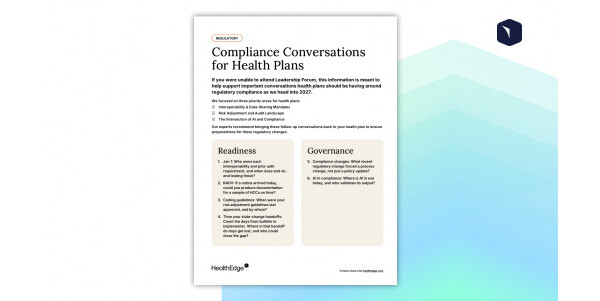
Sherwood emphasizes that security concerns are valid and describes HealthEdge’s focus on being explicit about how AI functions, including working with customers’ **compliance, legal, and security** teams. He also says HealthEdge builds AI features with future regulations in mind, aiming for systems that are **transparent, traceable, and auditable from day one**. Customers retain control over what is enabled, **AI-generated content is visually marked**, and **nothing is deployed automatically without customer agreement**. HealthEdge also established an **AI Governance Committee** spanning product, engineering, compliance, and security, aligned with emerging frameworks such as the **NIST Cybersecurity Framework**. (Section: “Q: What are the biggest AI-related concerns…”; Section: “Q: How does the Clinical Edge AI strategy support long-term compliance…”)
## Where AI shows up: care management, member experience, and operations
Sherwood points to the **Care Management Note Summarizer** as a concrete example: it reduces prep time by summarizing historical notes so a care manager doesn’t have to spend **“an hour”** digging through records before a call. He also notes work with vendor partners on tools that **transcribe and summarize conversations in real time** to reduce typing and let care managers focus on listening and supporting. From a member perspective, HealthEdge is exploring AI-driven ways to make information (like benefit coverage) more accessible and personalized, including experiments such as **AI-generated podcasts from written materials**. Across the broader ecosystem, HealthEdge describes **automation-first strategies** in operations, including **automating prior authorizations** to reduce manual touches and send only exceptions to staff. (Section: “Q: Can you give us an example of that in action?”; Section: “Q: Beyond care teams…”; Section: “Q: What does the future of AI look like…”)
## Conclusion: AI that solves real problems
Sherwood closes by stating HealthEdge is not building AI “for the sake of it,” but aiming for tools that solve real problems, save time, and support more human healthcare experiences—while prioritizing transparency and customer control. (Section: “Q: Bobby, do you have any final thoughts about developing AI tools?”)