




# Evaluating Digital Member Engagement Solutions: A Guide for Health Plans
## Key Facts
- **17% fewer inpatient admissions** and **$1,923 in average cost savings per member** are reported when health plans unify digital member engagement with care management. (Section: “Key Takeaways”)
- **One-third of members** are described as “very likely” or “likely” to switch insurance plans in the next year, making effective digital engagement a competitive priority. (Section: Intro, para 2)
- Clinical Edge (formerly **HealthEdge GuidingCare®**) reports measurable outcomes including **9% fewer emergency room visits**, **25% improvement in blood sugar control among diabetic members**, and **9% reduction in blood pressure for hypertensive members**. (Section: “Proven Performance Across Clinical and Operational Metrics”)
- Health plans using Clinical Edge report a **200% increase in care team caseload capacity** when engagement and care management workflows run in one unified member record. (Section: “A Connected Platform, Not a Point Solution”)
- The guide identifies **three common barriers** to effective digital member engagement: **disparate systems/integration gaps**, **unvalidated technologies**, and **vendor relationship complexity**. (Section: “What’s Holding Health Plans Back…”)
- The evaluation criteria for selecting a platform are organized into **four essential criteria**: **unified platform**, **data-driven results**, **scalability/continuous innovation**, and **seamless integration with care management**. (Section: “What Should Health Plans Look For…”)
## Summary
### Why digital member engagement platforms matter for health plans
Members increasingly expect clarity on care plans, real-time access to personalized guidance, and support navigating both health and benefits. The guide notes that when members have transparency into next steps and can interact continuously with care teams, they feel more confident and supported—and with **one-third of members** “very likely” or “likely” to switch plans in the next year, health plans face pressure to improve digital engagement. (Section: Intro, para 1–2)
### What blocks effective engagement: fragmentation, risk, and vendor sprawl
The guide highlights three reasons digital engagement efforts stall. First, health plans often operate **disconnected point solutions** that create **data silos**, inconsistent member experiences, and inefficient workflows—especially when interoperability with care management or **core administrative processing systems (CAPS)** is limited. Second, the market includes tools that promise results but lack demonstrated outcomes, creating strategic risk. Third, managing many vendors can drain administrative and IT resources and reduce agility. (Section: “What’s Holding Health Plans Back…”)
### What to look for when evaluating digital member engagement solutions
For selection and long-term success, the guide recommends platforms that meet **four criteria**: (1) a **comprehensive, unified platform** (ideally modular and configurable), (2) **demonstrated success with data-driven results** (including peer-reviewed studies and customer case studies) and implementation support aligned with organizations such as **Centers for Medicare and Medicaid Services (CMS)** and **National Committee for Quality Assurance (NCQA)**, (3) **scalability and continuous innovation** to adapt to evolving requirements (including **CMS interoperability mandates** and **NCQA Health Equity Accreditation**), and (4) **seamless integration with care management**, including embedded alerts, insights, and chat within care manager workflows. (Section: “What Should Health Plans Look For…”)
### Reported results and example: Clinical Edge
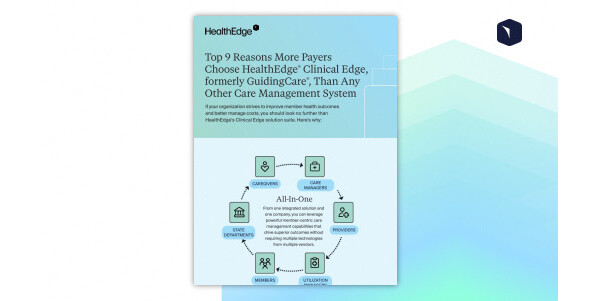
Clinical Edge (formerly **HealthEdge GuidingCare®**) is presented as an integrated care management solution that combines member engagement and care management workflows in one platform. The guide lists reported results at leading health plans, including **$1,923 in average cost savings per member**, **17% reduction in inpatient admissions**, **9% reduction in emergency room visits**, **25% improvement in blood sugar control among diabetic members**, and **9% reduction in blood pressure for hypertensive members**—as well as a reported **200% increase in care team caseload capacity** due to a single unified member record and real-time updates. (Section: “Proven Performance Across Clinical and Operational Metrics”; Section: “A Connected Platform, Not a Point Solution”)