







# Six regulatory developments health plans can’t afford to miss before January 1, 2027
## Key facts
- **January 1, 2027 is the shared effective date** for multiple major requirements and operational changes, including prior authorization API requirements, Medicaid community engagement/work requirements, and the American Medical Association (AMA) obstetrics billing restructure. (Section: “Key Takeaways”; Section: “Community Engagement and Work Requirements…”; Section: “The AMA Obstetrics Billing Restructure…”)
- **Digital accessibility enforcement timelines shifted:** a Department of Justice Interim Final Rule issued in **April 2026** extends ADA Title II digital accessibility compliance for **large entities** to **May 2028** for **WCAG 2.1 Level A and Level AA** conformance; the public comment period closes in **early July 2026**. (Section: “The WCAG 2.1 Extension Isn’t Permission to Wait”)
- **No Surprises Act IDR (Independent Dispute Resolution) rules changed in early June 2026**—including standardized remark codes on all out-of-network remittances, mandatory payer registration details on each initial payment or denial, and the federal IDR portal as the exclusive dispute initiation channel. (Section: “How Does the No Surprises Act IDR Final Rule Change Payer Operations?”)
- **Dispute volume is stated as 5.1 million annual submissions vs. an initial estimate of 22,000**, contributing to backlogs and administrative strain since the program launched in **April 2022**. (Section: “How Does the No Surprises Act IDR Final Rule Change Payer Operations?”)
- **Medicaid State Directed Payments (SDPs) proposed changes** (CMS proposed rule released **May 20, 2026**) include caps of **100% of Medicare rates** for Medicaid expansion states and **110%** for non-expansion states, effective for rating periods on or after **July 4, 2025**; the comment period closes **July 21, 2026**. (Section: “Medicaid State Directed Payments: What’s at Stake in the Proposed Rule?”)
- **AMA maternity coding changes on January 1, 2027:** **17 codes deleted, 12 new codes added, and six revised**; the American College of Obstetricians and Gynecologists (ACOG) recommends transitioning antepartum visit billing to unbundled evaluation and management (E/M) coding **no later than September 1, 2026**. (Section: “The AMA Obstetrics Billing Restructure: Why Planning Has to Start Now”)
## Summary
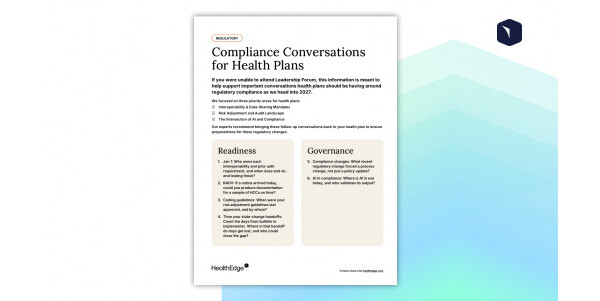
January 1, 2027 is positioned as a major convergence point for health plan compliance and operations, with multiple deadlines arriving at once—from the Centers for Medicare and Medicaid Services (CMS) Interoperability and Prior Authorization Final Rule (CMS-0057-F) API requirements to Medicaid community engagement/work requirements and the AMA obstetrics billing overhaul. The content emphasizes that timelines are tightening and that plans should prioritize cross-functional coordination now to avoid operational disruption. (Section: “Key Takeaways”; Section: “Prior Authorization and Interoperability APIs…”; Section: “6 Key Priorities…”)
### Prior authorization APIs and digital accessibility (WCAG 2.1)
For prior authorization and interoperability, the piece highlights readiness for CMS API deadlines and points to ongoing industry discussion around API implementation strategy, the emerging National Provider Directory, and provider data considerations. Separately, it notes that the Department of Justice issued an Interim Final Rule in April 2026 extending ADA Title II digital accessibility compliance for large entities to May 2028 for WCAG 2.1 Level A and Level AA, while warning that plans with federal or state contracts (including Medicare Advantage organizations, Medicaid managed care organizations, and Exchange issuers) may still face parallel accessibility and communications obligations tied to audits, oversight, and contract renewal cycles. (Section: “Prior Authorization and Interoperability APIs…”; Section: “The WCAG 2.1 Extension Isn’t Permission to Wait”)
### No Surprises Act IDR operations: new workflows and portal requirements
The content describes the No Surprises Act IDR Operations Final Rule (published in early June 2026) as the most comprehensive update since the program launched in April 2022, citing dispute volume far exceeding projections (5.1 million annual submissions vs. an initial estimate of 22,000). Operational changes called out include standardized remark codes on out-of-network remittances, mandatory payer registration information (legal business name, plan sponsor name, and registration number) tied to each initial payment or denial, exclusive use of the federal IDR portal for dispute initiation, batch disputes capped at 50 line items (with criteria), an administrative fee reduced from approximately $115 to $15 per party per dispute, and a phased centralized IDR gateway platform expected later in 2026. (Section: “How Does the No Surprises Act IDR Final Rule Change Payer Operations?”)
### Medicaid SDPs and Medicaid work requirements: caps, comments, and multi-state complexity
On Medicaid State Directed Payments, the piece summarizes a CMS proposed rule released May 20, 2026 with caps of 100% of Medicare rates in Medicaid expansion states and 110% in non-expansion states (effective for rating periods on or after July 4, 2025), plus provisions such as claim/service-level assessment and a phased reduction of grandfathered SDPs by 10 percentage points annually beginning with rating periods on or after January 1, 2028. It also stresses the comment deadline of July 21, 2026. For community engagement/work requirements, it states that the One Big Beautiful Bill Act (OBBBA), signed July 4, 2025, establishes Medicaid community engagement and work requirements with a federal implementation deadline of January 1, 2027, applying across “all 43 Affordable Care Act (ACA) expansion states, plus Georgia and Wisconsin,” with an 80-hours-per-month standard for able-bodied adults ages 19 to 64; it also notes Nebraska began enforcement May 1, 2026 (approximately 72,000 adults) and that Arkansas, Montana, and Iowa are implementing programs in July 2026. (Section: “Medicaid State Directed Payments…”; Section: “Community Engagement and Work Requirements…”)
### AMA obstetrics billing restructure: code deletions/additions and operational impact
Finally, the content details the AMA global maternity CPT code overhaul effective January 1, 2027, including retirement of existing global bundled CPT codes (17 deleted, 12 added, and six revised) and a shift to phase-specific billing across antepartum, labor management, delivery, and postpartum. It highlights ACOG’s recommendation to begin transitioning antepartum visits to unbundled E/M coding no later than September 1, 2026, and notes that values for new maternity codes may be proposed mid-2026 and finalized around November 2026 as part of the CY 2027 Physician Fee Schedule—while also stating that this timeline has not yet been confirmed by CMS. (Section: “The AMA Obstetrics Billing Restructure: Why Planning Has to Start Now”)