





# HealthEdge® Optimization Services: Unlock ROI & Efficiency for Health Plans
## Key Facts
- **$440B** is cited as **U.S. spending on healthcare**, alongside **$20B** in **potential savings through optimized electronic transactions** that address administrative complexity (Sources cited on page: “The 2024 CAQH Index Report,” “HealthAffairs Scholar,” and a 2023 paper; section near the top under “Why Health Plans Should Invest in Optimizing Their Systems”).
- **15%** is presented in the context that **optimization can reduce operating expenses** (same section: “Why Health Plans Should Invest in Optimizing Their Systems”; wording/formatting is unclear in the source and may be partially truncated).
- **98%** is shown in connection with **claims automation**, alongside the statement that **30% of claims manual processes require manual review** (Section: “Why Health Plans Should Invest in Optimizing Their Systems”; formatting appears compressed, but both figures are visible together).
- **Prior authorization costs** are listed as **MANUAL ($3.41)** vs. **ELECTRONIC ($0.05)**, highlighting the cost difference per authorization (Section: “Automate prior authorization”; “MANUAL ($3.41) … ELECTRONIC ($0.05) … per authorization”).
- Optimization is associated with **6.5%** (claims first-pass error rate) and improving **1–2 weeks** of claim processing time (Section: “Manually working claims adds”; the exact phrasing is partially truncated, but both figures are explicitly shown).
- HealthEdge is described as being **trusted by the health plan industry**, with **130+ health plans**, **10M+ lives covered**, and presence in **48 states** (Section: “HealthEdge: Trusted by the Health Plan Industry”).
## Summary
## Why health plans invest in optimization to reduce manual work and administrative costs
Health plans face high administrative complexity and significant cost differences between manual and electronic processes. The content highlights figures such as **$440B** in U.S. healthcare spending and **$20B** in potential savings through optimized electronic transactions. It also contrasts **manual prior authorization** costs (**$3.41**) with **electronic** costs (**$0.05**) per authorization, positioning automation and optimization as key levers for efficiency and cost savings.
## Optimization assessments for HealthRules® Edge and Clinical Edge
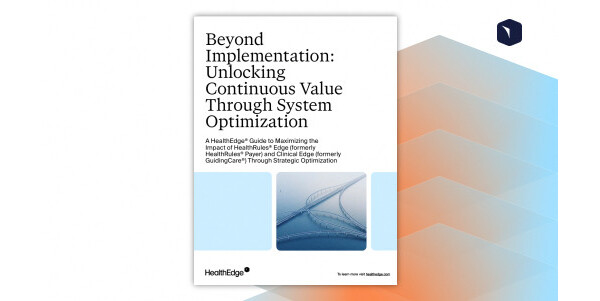
To “enhance your health plan technology systems,” the content recommends starting with an **Optimization Assessment**. For **HealthRules® Edge (formerly HealthRules® Payer)**, it outlines a **5-step methodology** that runs “from executive alignment to actionable ROI roadmap,” with common focus areas including optimizing **claims auto-adjudication**, streamlining processes to reduce manual work, and enabling new features and functionality. For **Clinical Edge (formerly HealthEdge Source)**, it describes a **3-step process** centered on leadership goals, end-user workflow review, and a tailored report, with focus areas such as streamlining and automating workflows, leveraging new functionality, and providing on-the-spot training.
## Expected outcomes and who benefits
The content frames optimization as beneficial for **members, health plan staff, and providers**. It ties improvements to faster service and “more accurate and automated prior authorizations and claims processing,” freeing employees for higher-value work, and helping expedite provider payments and reduce friction. It also summarizes outcomes across themes including increased automation and cost savings, improved operational productivity, improved member satisfaction, strengthened provider satisfaction, and better compliance readiness. HealthEdge positions itself as widely used across the industry, citing **130+ health plans**, **10M+ lives covered**, and **48 states**.