




# Adopting an AI-Powered Operational Infrastructure and Measuring ROI for Health Plans (Executive Discussion)
## Key Facts
- **Part 2 of a 2-part series** features HealthEdge® Vice President of Product Development **Bobby Sherwood** on how a new operating model can transform care operations for health plans (Intro).
- HealthEdge is **expanding the Clinical Edge solution (formerly HealthEdge Wellframe)** beyond an app to include **web, text-based, and email-based engagement** to “open more front doors” for member engagement (Section: “Investing in Member Engagement and Access”).
- For measuring ROI, the guidance is to **“just get started”** with a familiar use case, define what “better” means, and track outcomes such as **NCQA, HEDIS, or Star ratings** depending on the plan’s strategy (Section: “Measuring Success: Just Start”).
- The integrated ecosystem operating model is positioned as enabling HealthEdge to **“contractually guarantee outcomes”** because it controls “the entire technology stack and operational process,” not isolated components (Section: “Measuring Success: Just Start”).
- HealthEdge describes AI-powered tools that can conduct **telephonic conversations** for **annual health assessment completion**, while being transparent that the interaction is AI-assisted and prioritizing privacy and data security (Section: “Investing in Member Engagement and Access”).
- HealthEdge states that its Clinical Edge solution uses a **unified data model and API framework** to support **direct, real-time integration** with health plan systems and interoperability “out of the box” (Section: “Leverage Seamless Data Sharing & Transparency with Clinical Edge”).
## Summary
## How health plans can use AI-powered operations to improve engagement and prove ROI
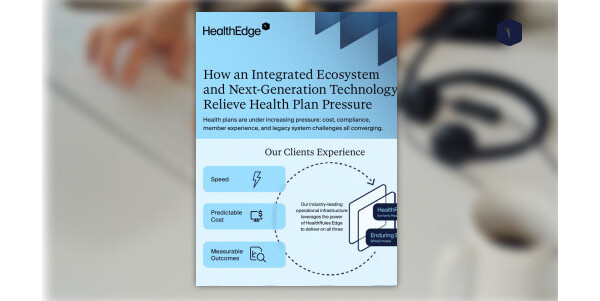
Health plans face pressure to engage members, improve outcomes, streamline operations, and demonstrate return on investment (ROI). In this executive discussion, HealthEdge VP of Product Development Bobby Sherwood explains how an integrated ecosystem operating model—supported by AI-powered operational infrastructure—aims to reduce administrative burden and help clinical teams focus on higher-value work (Sections: “Investing in Member Engagement and Access,” “The Future Operating Model”).
A central theme is improving member engagement through expanded digital access. HealthEdge says it is significantly expanding the **Clinical Edge solution (formerly HealthEdge Wellframe)** beyond a mobile app to also support **web, text-based, and email-based** engagement, with the goal of enabling more members to connect with care teams and participate in their care plans (Section: “Investing in Member Engagement and Access”).
## Measuring success and ROI: start with one measurable use case
For ROI measurement, Sherwood’s recommendation is to **start with a use case you already know**, partner with a team that can deliver measurable improvements, and clearly define what “better” means—examples include higher portal engagement, more completed assessments, closing more care gaps, or performance metrics such as **NCQA**, **HEDIS**, or **Star ratings** (Section: “Measuring Success: Just Start”). He emphasizes focusing on one area first, proving results, and then expanding with confidence (Section: “Measuring Success: Just Start”).
The discussion also highlights early steps to operational transformation. HealthEdge points to its **Advisory Services team** conducting a total cost of ownership assessment to identify cost drivers and select a starting line-of-business use case. Examples given include **post-discharge follow-up, member enrollment, or assessment completion**, described as measurable interventions where the intervention-to-outcome relationship is well established (Section: “Steps to Operational Transformation”).
## Data sharing, interoperability, and transparency as foundations
HealthEdge frames interoperability and data sharing as differentiators, stating that Clinical Edge uses a **unified data model and API framework** to enable **direct, real-time integration** with health plan systems and to support direct documentation, automations, and intelligence within systems (Section: “Leverage Seamless Data Sharing & Transparency with Clinical Edge”). The piece closes by positioning adoption of an ecosystem operating model as both an operational shift and a business model innovation for health plans navigating ongoing cost and regulatory pressures (Sections: “Leverage Seamless Data Sharing & Transparency with Clinical Edge,” “Future-Proofing Health Plan Operations with AI-Powered Solutions”).