
Key Takeaways
- Claims editing goes beyond basic checks. It requires matching every claim against provider contracts, state and federal regulations, and medical necessity standards.
- Payment accuracy, operational efficiency, and cost management remain critical priorities for health plans navigating a complex claims landscape.
- Disconnected vendors and fragmented systems, not a lack of effort, are often the root cause of claims errors and rework.
What Does It Take to Pay a Claim Correctly?
Paying a claim correctly requires far more than a surface-level check. Every claim must align with provider contract terms, comply with state and federal regulations, and demonstrate medical necessity before a health plan can pay it accurately. The challenge for most health plans lies in navigating diverse payment policies while minimizing delays or rework, and that balancing act sits at the heart of payment accuracy.
Payment accuracy, operational efficiency, and cost management are critical priorities for health plans navigating an increasingly complex claims landscape. Errors in claims processing disrupt operational workflows, increase administrative expenses, and strain relationships with healthcare providers. Health plans that get this right protect both their bottom line and their provider partnerships.
In the HealthEdge® webinar, “Path to Payment Accuracy,” experts shared actionable ways health plans can address common obstacles to claims accuracy. Below, we highlight five of the most common challenges health plans face during claims processing and how Payment Accuracy Edge®, formerly HealthEdge Source™, helps drive cost savings by improving accuracy and efficiency.
5 Challenges Health Plans Face with Claims Management
The claims payment process often involves multiple, disparate technologies. Juggling several vendors instead of relying on integrated infrastructure creates workflow inefficiencies and drives up operating costs. If claims management feels overwhelming, your organization isn’t alone. Below are five of the most common challenges health plans encounter, along with the operational and financial impact each one creates.
- Regulatory Complexity: Staying on top of updates from the Centers for Medicare and Medicaid Services (CMS), state Medicaid programs, and other federal agencies requires meticulous oversight and prompt action. Health plans often struggle to keep up with the pace of change, leading to non-compliance risks and operational disruption.
- **Fragmented vendor ecosystems: **Many health plans rely on a fragmented approach with multiple vendors managing separate parts of post-pay processes. This “stacked vendor” system makes it difficult to maintain a single source of truth and can lead to inefficiencies, delayed guideline updates, varying data accuracy, and higher administrative costs. Without centralized data, health plans often catch payment inaccuracies only after they’ve already caused provider disputes or member complaints.
- Rising administrative costs: On average, each medical claim carries a financial cost of $12 to $19. Complex manual processes and workflow inefficiencies in claim processing can significantly increase these administrative costs. Reliance on manual claims processing also causes issues for health systems, costing an average of $5 million in losses per year and increasing provider abrasion.
- **Limited internal editing capabilities: **Many health plans lack effective in-house tools to align claims editing and pricing systems. Relying on disparate third-party claims editing systems can create mismatches between pricing, policies, and regulations—leading to denials and rework.
- Provider abrasion: Delays, rework, and reimbursement issues damage provider trust in your health plan, making an already complex system even harder to manage.
Health Plan Priorities: Claims Processing & Payment Integrity
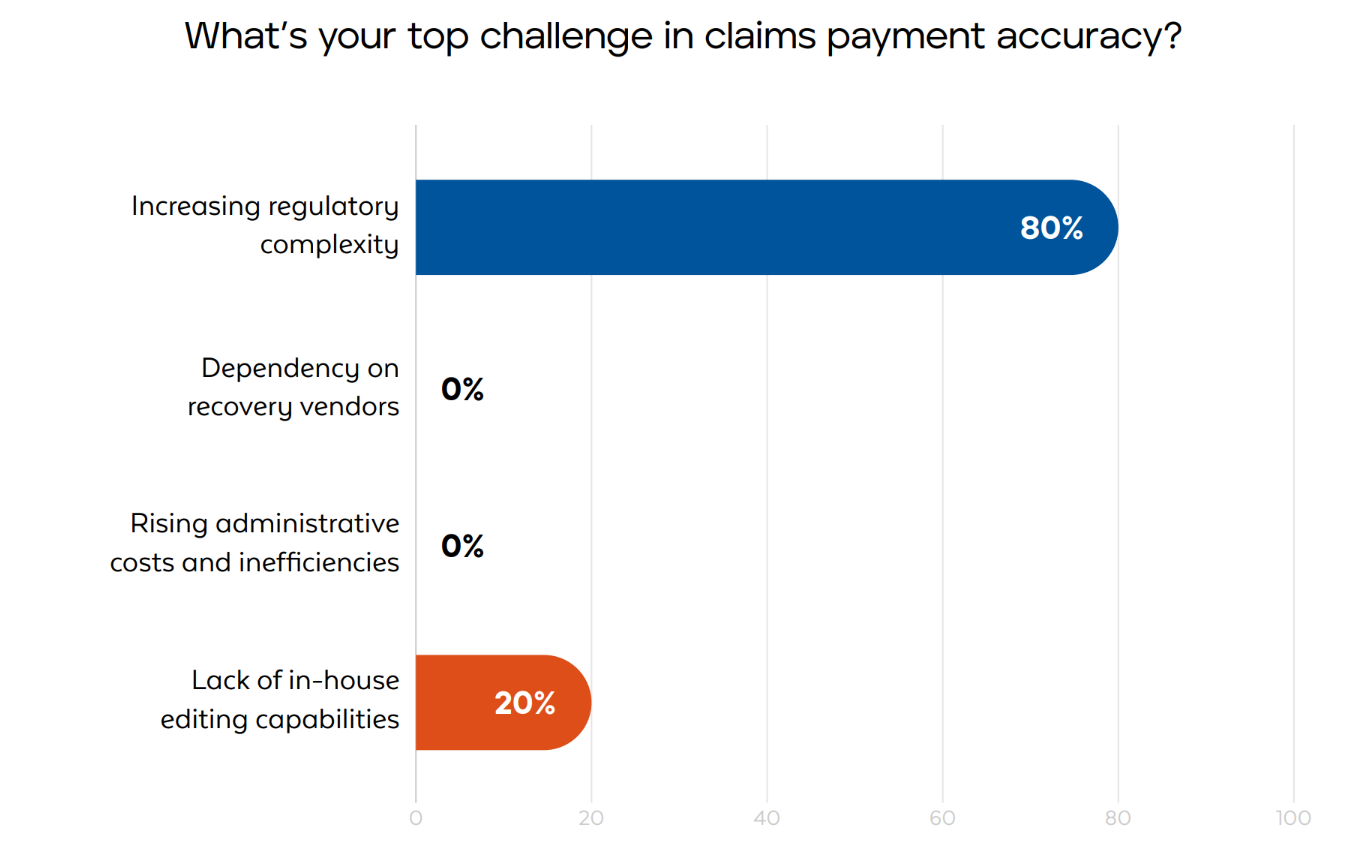
“Increasing regulatory complexity” emerged as a primary concern for payers, followed closely by a “lack of in-house claims editing capabilities.” These findings highlight that staying compliant while managing cost and operational efficiency remains a delicate balance.
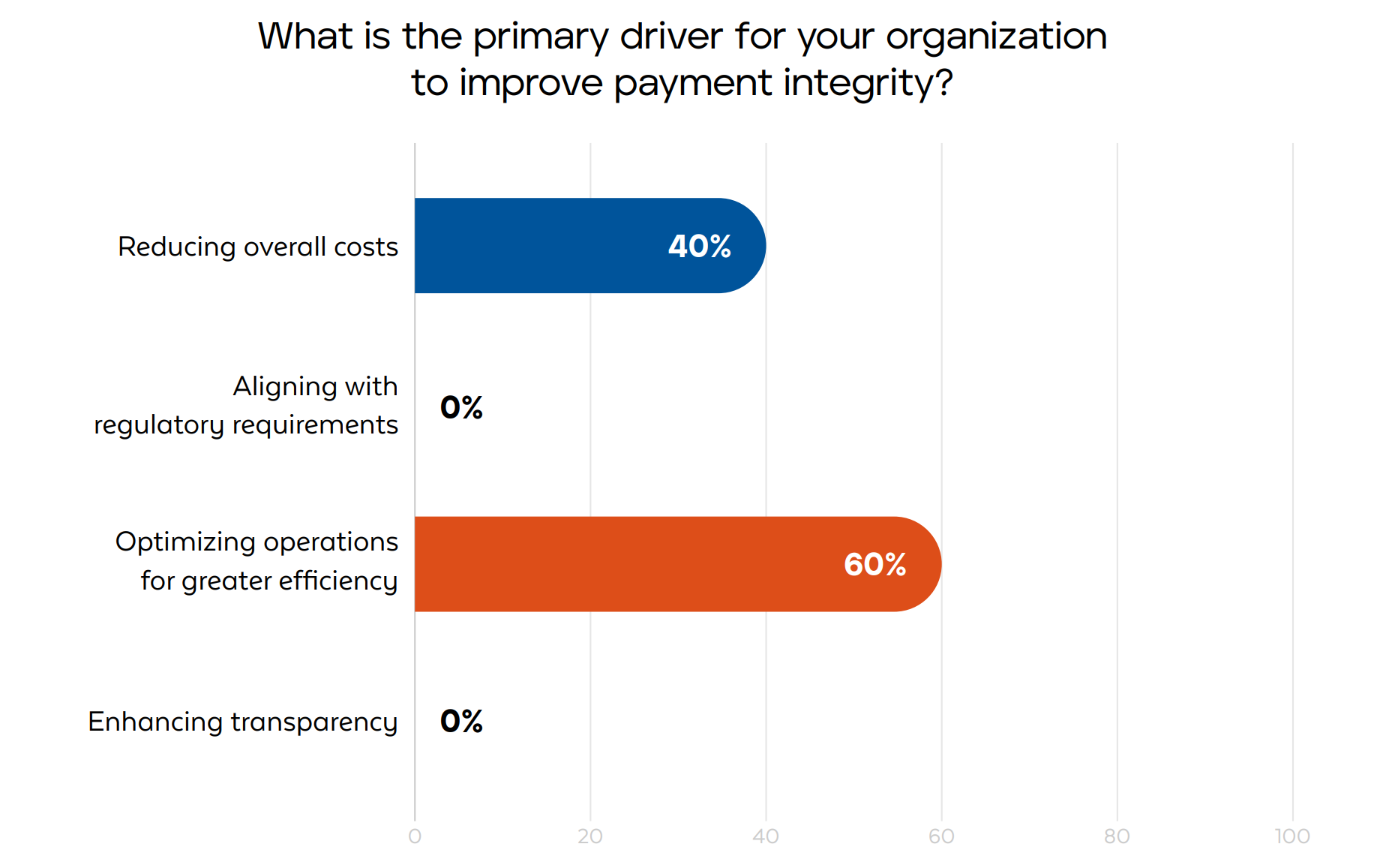
Many payers identified “reducing overall costs” and “optimizing operations for efficiency” as the main drivers for modernizing payment integrity efforts. These priorities go hand-in-hand as health plans strive to streamline workflows and eliminate wasteful spending.
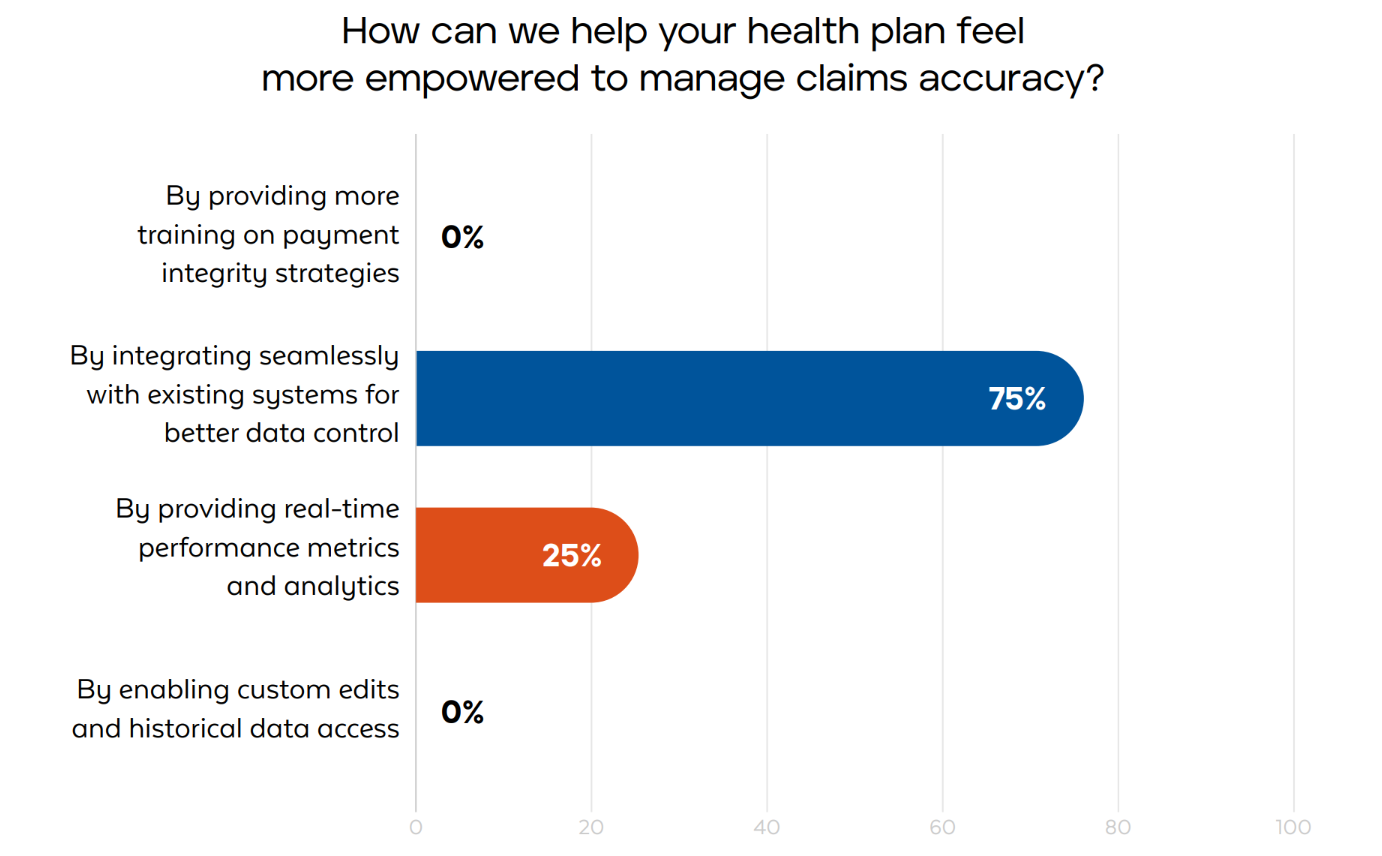
Webinar participants emphasized the need for “real-time performance metrics” and “stronger system integrations” as critical enablers for success. Streamlined insights and a cohesive ecosystem are essential for navigating the complexities of payment integrity.
How Does an Integrated Platform Improve Payment Accuracy?
An integrated, AI-powered platform resolves these challenges by unifying claims pricing, editing, and analytics into a single system of record. Payment Accuracy Edge, processes claims in an average of 200 milliseconds while sustaining 99.9% uptime for its clients.
Real-Time Claims Accuracy
With Payment Accuracy Edge Editing, claims processing is automated to streamline operations and reduce the need for manual review. Automating processes helps cut down on expensive claims rework and reduces provider abrasion due to delays.
Our payment integrity and accuracy solution combines editing, pricing, and analytics into one integrated system, catching errors and flagging inconsistencies in real-time. This proactive approach uncovers the root causes behind recurring payment issues, enabling health plans can fine-tune their processes, implement corrective strategies, and address systemic inefficiencies, all while maintaining a clear focus on cost containment and operational excellence.
Regulatory Compliance Made Easy
Payment Accuracy Edge simplifies compliance for health plans through cloud-based, regulatory updates, eliminating the burden on your internal teams. The platform is fully customizable for state and payer-specific requirements, giving your health plan the flexibility to adapt to shifting guidelines. With constantly updated code edits, automated claims auditing, and detailed audit trails, staying compliant has never been easier.
For example, HealthEdge policy experts made more than 1,800 updates to support payment accuracy in a single year, all delivered on a two-week cycle that kept health plans aligned with the latest CMS and industry changes.
Actionable Business Intelligence
The Payment Accuracy Edge solution provides transparent insights into claims performance through a unified interface. The modeling tool allows health plan teams to test and refine new edits before implementation, reducing errors and ensuring alignment with business goals. And advanced analytics highlight trends and potential challenges, enabling health plans to make data-driven decisions and proactively adapt to emerging demands.
Seamless Integration
Payment Accuracy Edge seamlessly integrates with existing claims systems, third-party tools, and pricers to enhance capabilities without costly disruptions. Third-party integrations make it easier for payers to streamline data flow, eliminate silos, and enable real-time validation, ensuring accurate claims processing and payment calculations upfront. Leveraging third-party tools also helps improve fraud detection and data enrichment. The result is a cohesive ecosystem that allows your health plan to deliver both financial and operational excellence without compromise.
Rather than stitching together disparate systems, health plans running an integrated platform gain a centralized configuration layer for their proprietary rules, industry content, and third-party integrations. That structure supports proactive, root-cause remediation instead of reactive fixes, and it gives operations teams enterprise-wide visibility into how claims move through the payment cycle.
Make Accurate Payments in Real Time with Payment Accuracy Edge
Health plans don’t have to choose between accuracy and efficiency. With the right integrated infrastructure, both are achievable at scale. Learn more about the forces driving payment inaccuracies, the business impact on payers, and how embedded AI reshaping how leading health plans transition from reactive payment approach to proactive, scalable payment integrity.
Download our white paper: Elevating Payment Integrity—The Role of AI in Enhancing Payment Accuracy
Frequently Asked Questions
What role does automation play in reducing claims errors?
Automation applies the most current payment policies and regulatory guidelines directly at the point of claim submission, which reduces manual rework and catches errors before they reach payment. This proactive approach lowers administrative costs and reduces provider disputes tied to reimbursement inaccuracies.
How can health plans measure improvements in payment accuracy?
Health plans can track metrics such as claims processing volume, average processing time, and the frequency of post-payment corrections. Platforms that process high claims volumes, such as 375,000 production claims per day, provide the scale of data needed to benchmark accuracy improvements over time.